field bindweed
(Convolvulus arvensis)
Overview
- Appearance
- Convolvulus arvensis is a perennial vine. It is weak-stemmed and prostrate. Stems twine and can grow to 5 ft. (1.5 m) or longer. C. arvensis has deep, spreading roots and rhizomes. It is native to Africa, temperate and tropical Asia and Europe.
- Foliage
- Leaves are round to arrow-shaped, 1-2.25 in. (2.5-5.7 cm) long, and alternate.
- Flower
- Flowering occurs in the mid-summer, when white to pale pink, funnel-shaped flowers develop. Flowers are approximately 0.75-1 in. (1.9-2.5 cm) across and are subtended by small bracts.
- Fruit
- Fruit are light brown, rounded, and 0.13 in. (0.3 cm) wide. Each fruit contains two seeds.
- Ecological Threat
- C. arvensis most likely was introduced in North America as a contaminant in crop seed as early as 1739. Plants typically inhabit roadsides and grasslands and live along streams.
Resources
- Federal Noxious Weed Disseminules of the U.S. - USDA-APHIS
- Weed of the Week - USDA Forest Service
Selected Images
Maps
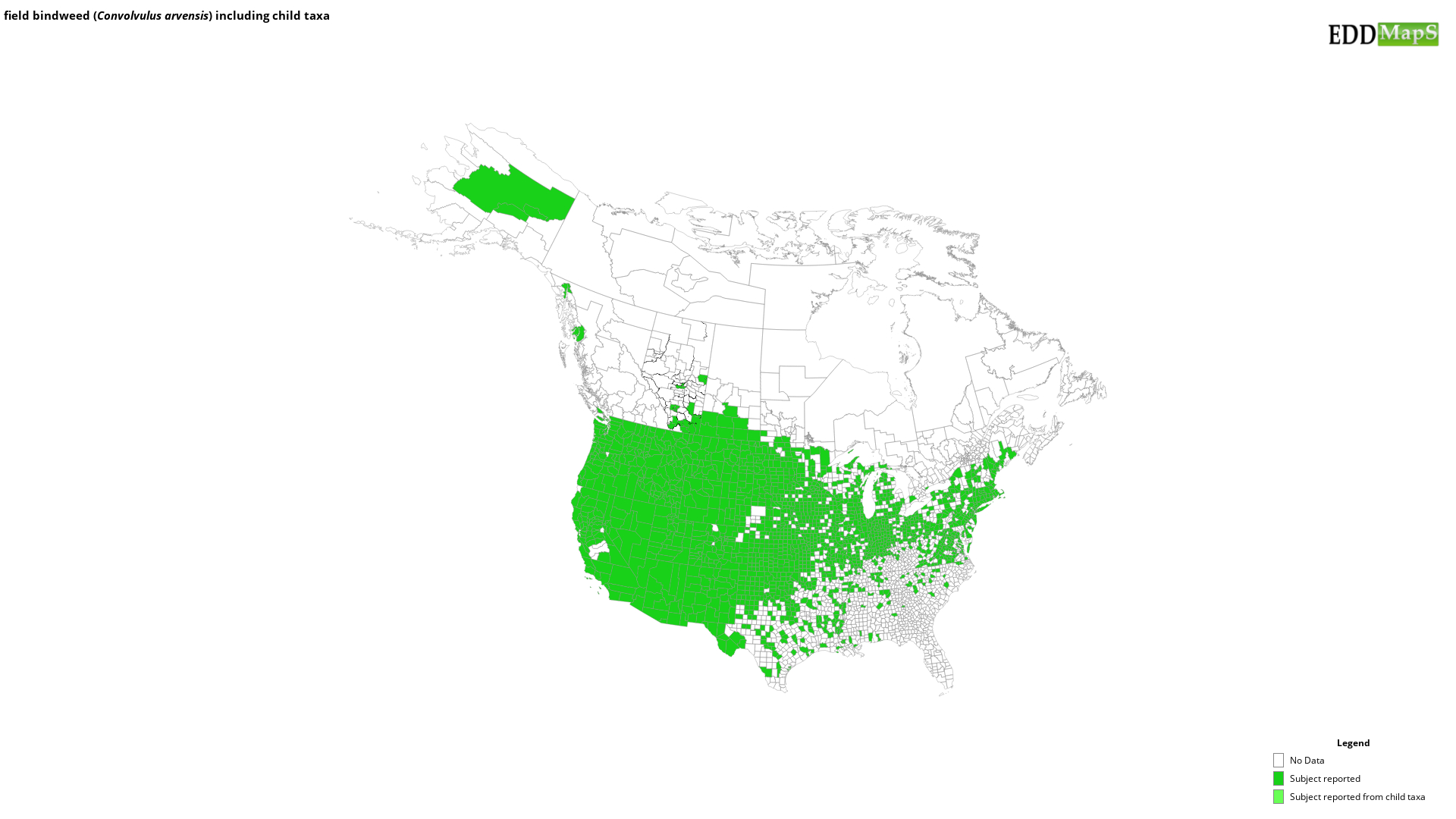
EDDMapS Distribution - This map is incomplete and is based only on current site and county level reports made by experts, herbaria, and literature. For more information, visit www.eddmaps.org

State List - This map identifies those states that list this species on their invasive species list or law. For more information, visit Invasive.org
Invasive Listing Sources
- Alaska Noxious Weeds
- Alberta Weed Control Act
- Arizona Noxious Weeds
- California Noxious Weeds
- City of Ann Arbor Michigan Parks and Recreation
- Colorado Noxious Weeds
- Hawaii Noxious Weeds
- Hoffman, R. & K. Kearns, Eds. 1997. Wisconsin manual of control recommendations for ecologically invasive plants. Wisconsin Dept. Natural Resources, Bureau of Endangered Resources. Madison, Wisconsin. 102pp.
- Idaho Noxious Weeds
- Indiana Invasive Species Council - Invasive Plant List
- Indiana Terrestrial Plant Rule
- Invasive Plant Association of Wisconsin
- Invasive Plant Species of West Virginia
- Iowa Noxious Weeds
- Jil M. Swearingen, Survey of invasive plants occurring on National Park Service lands, 2000-2007
- John Randall, The Nature Conservancy, Survey of TNC Preserves, 1995.
- Kansas Noxious Weeds
- Kentucky Exotic Pest Plant Council - Moderate Threat
- Maryland Code and Regulations Noxious Weed & Seed Law
- Michigan Noxious Weeds
- Missouri Noxious Weeds
- Montana Noxious Weeds
- National Park Service, Mid-Atlantic Exotic Plant Management Team Invasive Plant List
- Native Plant Society of Oregon, 2008
- New Hampshire Invasive Plant Species Watch List
- Nonnative Invasive Species in Southern Forest and Grassland Ecosystems
- Ohio Invasive Species Council
- Ohio Noxious Weeds
- Oregon Noxious Weeds
- Pacific Northwest Exotic Pest Plant Council, 1998
- Texas Noxious Weeds
- Utah Noxious Weeds - Contain
- Washington Noxious Weeds
- WeedUS - Database of Plants Invading Natural Areas in the United States
- West Virginia Native Plant Society, Flora West Virginia Project, and West Virginia Curatorial Database System, September 3, 1999
- Wyoming Noxious Weeds
Taxonomic Rank
| Kingdom: Plantae |
| Phylum: Magnoliophyta |
| Class: Magnoliopsida |
| Subclass: Asteridae |
| Order: Solanales |
| Family: Convolvulaceae |
| Genus: Convolvulus |
| Subject: Convolvulus arvensis L. |
Other System Links
Plants: COAR4
Bayer: CONAR
GRIN: 11287
ITIS: 30705
NPDN Pest: PBGACBB
NPDN Host: 31526
Synonyms and Other Names
Other Common Names:
creeping jenny, European bindweed, morningglory, perennial morningglory, smallflowered morning glory
Related Scientific Names:
Convolvulus ambigens L. (Synonym)
Strophocaulos arvensis L. (Synonym)